
What Happens After an FIR Is Registered in India? Step-by-Step Legal Guide
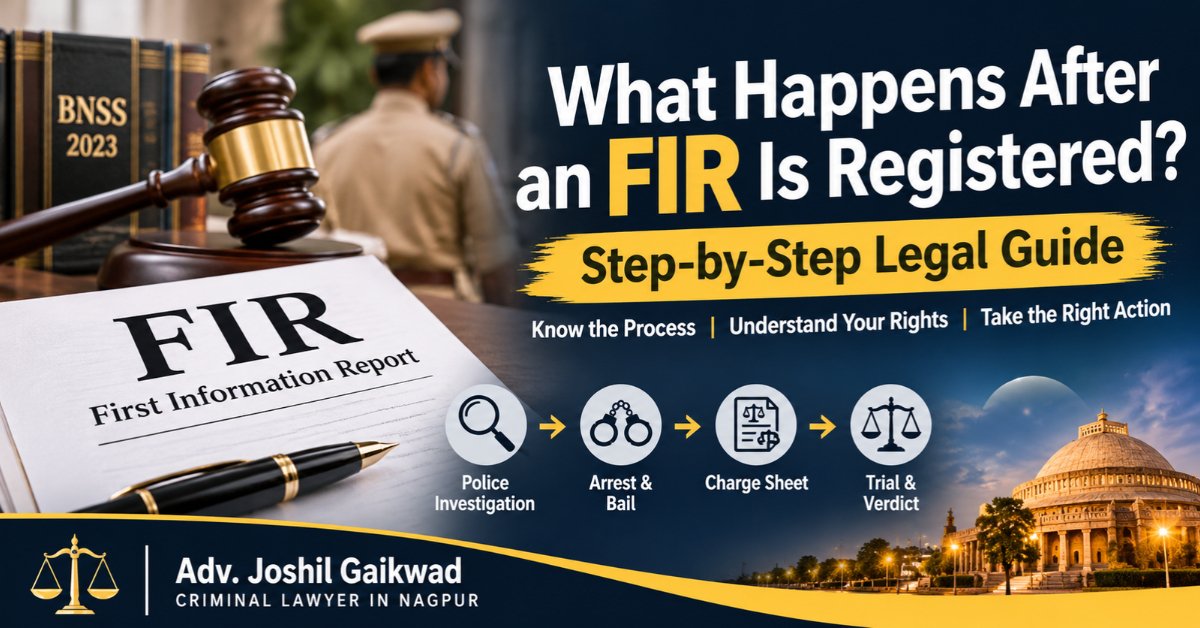
Summary: An FIR is often the first major step in a criminal case, but what follows can significantly impact both the complainant and the accused. From police investigation and evidence collection to arrest, bail and filing of a charge sheet, every stage involves important legal procedures. Understanding what happens after an FIR is registered in India can help you protect your rights and take informed action. Explore this step-by-step guide to understand the FIR process under the BNSS, 2023, and the legal options available at each stage.
Receiving an FIR copy or learning that an FIR has been registered against you can raise several concerns. What happens next? Can the police arrest the accused immediately? How long does the investigation take? Understanding the procedure after FIR registration can help both complainants and accused persons make informed decisions.
Under the Bharatiya Nagarik Suraksha Sanhita (BNSS), 2023, which came into effect on 1 July 2024, an FIR generally initiates the investigation process in a cognizable offence. From evidence collection and witness statements to arrest, bail and filing of a charge sheet, this guide explains what happens after an FIR is registered in India and the legal rights you should know.
Quick Answer: What Happens Immediately After FIR Registration?
After an FIR is registered for a cognizable offence, the police generally begin investigating the allegations. An investigating officer may visit the crime scene, collect evidence, record witness statements, examine documents and electronic records, and question relevant persons.
Depending on the circumstances and legal requirements, the police may also arrest the accused or issue a notice to appear for questioning. After completing the investigation, the police submit a final report before the competent Magistrate. This may be a charge sheet or a closure report, depending on the findings.
An important point: Registration of an FIR does not automatically mean that the accused will be arrested or found guilty.
What Is an FIR Under Indian Law?
An FIR, or First Information Report, is the formal record of information given to the police regarding the commission of a cognizable offence. Under Section 173 of the Bharatiya Nagarik Suraksha Sanhita, 2023, information relating to a cognizable offence can be provided orally or through electronic communication to the officer in charge of a police station.
When information is provided orally, the police must reduce it to writing and read it over to the informant before obtaining their signature. Information received electronically must be signed by the person providing it within three days. The informant or victim is entitled to receive a copy of the recorded information free of cost.
What Is a Cognizable Offence?
A cognizable offence is one in which the police have the authority to arrest without a warrant and investigate without first obtaining an order from a Magistrate, subject to the applicable legal requirements.
Examples may include certain serious offences involving theft, robbery, assault and other crimes, depending on their statutory classification.
What Is a Non-Cognizable Offence?
A non-cognizable offence is one in which the police generally cannot arrest without a warrant or order of a Magistrate. Under Section 174 of BNSS, police ordinarily require a Magistrate’s order to investigate such an offence.
What Is a Zero FIR?
A Zero FIR allows a person to report a cognizable offence at any police station, irrespective of the location where the incident occurred.
Under Section 173 of BNSS, information about a cognizable offence can be provided irrespective of the area where the offence was committed. The FIR can subsequently be transferred to the police station having the appropriate territorial jurisdiction.
Does an FIR Mean That the Accused Is Guilty?
No. An FIR is not proof that the accused has committed the alleged offence.
It records the initial information received by the police and provides the basis for investigating the allegations. Guilt or innocence is ultimately determined through the applicable judicial process.
What Happens After an FIR Is Registered? Step-by-Step Process
Once an FIR is registered, the police follow the investigation procedure prescribed under the BNSS. The exact steps may differ depending on the nature of the alleged offence, available evidence and circumstances of the case.
Here is a step-by-step explanation of what generally happens next.
Step 1: Police Begin the Investigation
After receiving information about a cognizable offence and registering an FIR, the police initiate the investigation.
Under Section 175 of BNSS, the officer in charge of a police station has the authority to investigate a cognizable case without obtaining prior permission from a Magistrate, subject to the law.
The investigation may involve:
- Understanding the allegations mentioned in the FIR.
- Visiting the location where the incident allegedly occurred.
- Identifying witnesses and other persons connected with the incident.
- Collecting relevant documents and physical evidence.
- Examining available CCTV footage and electronic records.
- Identifying possible suspects.
- Taking necessary steps to preserve evidence.
The objective of the investigation is to establish the facts and determine whether sufficient evidence exists to proceed against the accused.
Important: For certain cognizable offences punishable with imprisonment of three years or more but less than seven years, Section 173(3) of BNSS permits a preliminary inquiry, with prior permission from an officer not below the rank of Deputy Superintendent of Police. This inquiry must be completed within 14 days to determine whether a prima facie case exists. This is a limited statutory provision, not a general investigation deadline.
Step 2: An Investigating Officer Is Assigned
An Investigating Officer (IO) is the police officer responsible for conducting the investigation of a criminal case. The officer examines the allegations, gathers relevant information and takes appropriate steps to establish the facts.
The responsibilities of an investigating officer generally include:
- Examining the FIR and understanding the allegations.
- Recording statements of relevant persons.
- Collecting and preserving evidence.
- Conducting searches and seizures where legally authorised.
- Questioning relevant individuals.
- Preparing investigation records.
- Submitting the police report after completing the investigation.
The investigating officer must follow the applicable legal procedure and examine relevant material objectively.
Step 3: Police Collect Evidence and Documents
Evidence collection is one of the most important stages of the FIR investigation process.
The police collect material that may help establish what happened and whether an offence has been committed.
Depending on the nature of the case, the evidence may include:
Type of evidence | Examples |
Physical evidence | Weapons, damaged property, fingerprints |
Documentary evidence | Agreements, receipts, written records |
Digital evidence | CCTV footage, emails, messages, call records |
Medical evidence | Injury reports and medical examination records |
Financial evidence | Bank statements and transaction records |
Forensic evidence | DNA samples and laboratory reports |
In cases involving offences punishable with seven years or more, Section 176(3) of BNSS provides for forensic expert visits to crime scenes and videography of the evidence collection process, subject to the applicable commencement notifications and implementation arrangements.
Electronic evidence must also be handled appropriately so that its authenticity and chain of custody can be examined.
Why is this important?
A criminal investigation should not depend only on the allegations made in the FIR. Relevant evidence supporting or contradicting those allegations must also be examined.
Step 4: Police Record Witness Statements
After an FIR is registered, the investigating officer may identify and examine people who have information about the incident.
Under Section 179 of BNSS, police may require certain persons acquainted with the facts and circumstances of the case to attend for examination through a written order, subject to statutory safeguards and exceptions.
Under Section 180, the police may examine witnesses and record their statements.
Witnesses may include:
- The complainant.
- People who witnessed the incident.
- Individuals who have relevant information.
- Persons connected with the alleged transaction.
- Medical professionals or other experts, where relevant.
Section 181 deals with statements made to police during investigation and their use in subsequent proceedings. Such statements are generally not signed by the person making them and are subject to restrictions on their evidentiary use.
If a confession or statement needs to be formally recorded by a Magistrate, Section 183 of BNSS provides the relevant procedure.
Step 5: Police May Question the Accused
After registering an FIR, the police may require the accused or a person suspected of involvement to participate in the investigation.
The purpose of questioning is to obtain relevant information, clarify circumstances and examine the person’s possible involvement.
Depending on the case, police may ask questions about:
- The person’s whereabouts at the time of the incident.
- Their relationship with the complainant.
- Documents or objects connected with the alleged offence.
- Communications or transactions relevant to the investigation.
- Other circumstances mentioned in the FIR.
However, being called for questioning does not automatically mean that a person has been arrested or found guilty.
A person should respond appropriately to lawful police notices and avoid giving false information, destroying evidence or attempting to influence witnesses.
Step 6: Can Police Arrest Someone Immediately After FIR Registration?
This is one of the most common concerns after an FIR is registered.
No, arrest is not automatic merely because an FIR has been registered.
The police must follow the conditions prescribed under Section 35 of BNSS before making an arrest without a warrant.
For offences punishable with imprisonment of up to seven years, the police must consider whether arrest is necessary for legally recognised purposes, such as preventing further offences, proper investigation, preventing evidence tampering or ensuring the accused’s presence in court.
The officer must record reasons for making an arrest and, where arrest is not required, record reasons for not making one.
For offences punishable with imprisonment exceeding seven years or with death, Section 35 contains separate statutory grounds for arrest.
When Can Police Issue a Notice Instead of Making an Arrest?
Under Section 35(3) of BNSS, where arrest is not required, the police must issue a notice directing the person to appear before them or at another specified place. If the person complies with the notice and continues to comply, they should not ordinarily be arrested in connection with that offence unless the police officer records reasons why arrest has become necessary.
This provision is particularly important for understanding why every FIR does not lead to immediate arrest.
What Are Your Rights If You Are Arrested?
A person who is arrested has important legal and constitutional protections, including:
- The right to be informed of the grounds of arrest.
- The right to consult and be defended by an advocate.
- The right to inform a relative or friend about the arrest, as required by law.
- The right to be produced before a Magistrate within 24 hours, excluding the time necessary for the journey, as prescribed by law.
- Protection against unlawful detention.
- The right to seek bail where legally available.
Section 38 of BNSS also recognises the right of an arrested person to meet an advocate of their choice during interrogation, though not throughout the entire interrogation.
Difference Between Police Custody and Judicial Custody
Police custody | Judicial custody |
The accused remains in police custody under a Magistrate’s authorisation. | The accused remains in the custody of the judicial system, generally in jail. |
Police may conduct custodial interrogation as permitted by law. | The accused is not ordinarily available to police for interrogation without appropriate court permission. |
Subject to the limits and conditions under Section 187 BNSS. | Continued detention requires judicial authorisation. |
An arrested person may also explore appropriate bail remedies depending on the nature of the offence, including regular bail or anticipatory bail where legally applicable.
Step 7: Police May Conduct Searches, Seizures and Forensic Examinations
During an investigation, the police may need to search premises, seize relevant objects or examine electronic devices connected with the alleged offence. Such actions must comply with the applicable legal requirements.
For example:
- Section 185 of BNSS deals with searches by police officers during investigation.
- Section 105 provides for audio-video recording of specified search and seizure processes.
- Section 176 provides the procedure for investigation and relevant crime-scene measures.
Depending on the circumstances, police may examine mobile phones, computers, financial records, CCTV footage, documents or other materials.
The purpose is to identify evidence relevant to the allegations and establish the circumstances of the alleged offence.
Step 8: Police Complete the Investigation
After collecting evidence, examining witnesses and taking other necessary investigative steps, the police evaluate the material gathered during the investigation.
They examine whether the evidence supports the allegations, whether an offence appears to have been committed and whether any person appears to be involved. The investigation may result in different outcomes depending on the evidence.
For example:
- Evidence may support prosecution of the accused.
- Evidence may be insufficient to establish the alleged offence.
- Further investigation may be necessary.
- The available material may support submission of a closure report.
The investigating officer must follow the applicable procedure and submit the appropriate report before the competent Magistrate.
Step 9: Police File a Charge Sheet or Closure Report
After completing the investigation, the police submit a report under Section 193 of BNSS. There are two important possible outcomes.
What Is a Charge Sheet?
A charge sheet is the police report submitted before the competent court when the investigation indicates that an offence appears to have been committed and identifies the person or persons against whom prosecution is proposed.
It generally contains:
- Details of the accused and complainant.
- Nature of the allegations.
- Details of witnesses.
- Evidence collected during the investigation.
- Relevant documents and reports.
- Findings of the investigating officer.
- Other information required under the law.
The Magistrate or competent court examines the report and decides the appropriate judicial course.
Filing a charge sheet does not mean that the accused has been convicted.
What Is a Closure Report?
A closure report may be submitted when the investigation does not disclose sufficient grounds to proceed with prosecution or when the findings support closure under the applicable law. However, the police cannot simply treat the case as closed without following the required judicial procedure.
The Magistrate may consider the closure report and take an appropriate decision. If the Magistrate proposes to accept a closure report, the informant must be given an opportunity to be heard in accordance with the applicable law.
The complainant may also submit a protest petition challenging the proposed closure.
Important difference:
Charge sheet | Closure report |
Submitted when police findings support prosecution. | Submitted when police findings support closure. |
The court considers whether to proceed with the case. | The court considers whether to accept or reject the closure recommendation. |
Does not establish guilt. | Does not automatically end the case. |
Step 10: What Happens After the Charge Sheet Is Filed?
Once the police submit a charge sheet, the matter moves into the judicial process.
The next steps depend on the nature of the offence and the court’s jurisdiction.
Generally, the process may involve:
- Judicial consideration: The Magistrate examines the police report and decides whether to take cognizance of the alleged offence.
- Appearance of the accused: The accused appears before the competent court as required.
- Supply of documents: Under Section 230 of BNSS, the Magistrate must provide the prescribed copies of the police report, FIR and relevant documents to the accused and the victim, if represented by an advocate, without delay and ordinarily within 14 days of the accused’s production or appearance.
- Committal where required: Cases exclusively triable by a Court of Session are committed to that court under the applicable procedure.
- Consideration of charges: The court considers whether charges should be framed or the accused discharged, as applicable.
- Trial proceedings: If the case proceeds to trial, evidence is presented and witnesses may be examined and cross-examined.
- Final judgment: The court ultimately decides the case based on the evidence and applicable law.
It is important to understand that the filing of an FIR, completion of investigation, submission of a charge sheet and final judgment are separate stages of criminal proceedings.
What Are Your Legal Rights After an FIR Is Registered?
Whether you are the person who filed the FIR or the person named as an accused, understanding your legal rights is essential.
Indian criminal law provides safeguards to both parties throughout the investigation and judicial process.
Rights of the Complainant or Victim
A person who reports a cognizable offence has certain rights during the investigation.
Some important rights include:
- Right to receive an FIR copy: Under Section 173(2) of BNSS, the informant or victim is entitled to receive a free copy of the recorded information.
- Right to fair investigation: The investigation must be conducted according to law, without improper influence or unnecessary delay.
- Right to provide evidence: The complainant can provide relevant documents, photographs, videos, communications and other information to the investigating officer.
- Right to investigation progress information: Under Section 193(3)(ii) of BNSS, the police must inform the informant or victim about the progress of the investigation within 90 days.
- Right to approach senior police authorities: If the police fail to take appropriate action, the complainant may pursue remedies available under BNSS.
- Right to challenge a closure report: The complainant may place objections before the competent Magistrate when the police recommend closing the case.
These rights help ensure that a complaint is dealt with through the appropriate legal process.
Rights of the Accused Person
Being named in an FIR does not mean that a person is automatically guilty.
The accused also has important rights that must be respected during investigation and criminal proceedings.
These include:
- Right to know the grounds of arrest: If arrested, the person must be informed of the grounds of arrest as required by law.
- Right to legal representation: The accused has the right to consult and be defended by an advocate of their choice.
- Protection against unlawful arrest: Police must comply with the statutory conditions governing arrest.
- Right to seek bail: Depending on the nature of the offence, the accused may apply for regular bail or anticipatory bail.
- Protection against self-incrimination: Article 20(3) of the Constitution protects an accused person from being compelled to be a witness against themselves.
- Right to be produced before a Magistrate: A person arrested without a warrant must ordinarily be produced before a Magistrate within 24 hours, excluding journey time.
- Right to relevant case documents: The accused is entitled to the documents prescribed under Section 230 of BNSS at the applicable stage.
Understanding these safeguards is particularly important when someone discovers that an FIR has been registered against them.
What If Police Do Not Investigate an FIR?
One of the most frustrating situations for a complainant is registering an FIR but seeing little or no progress in the investigation.
If the police are not taking appropriate action, the complainant may have legal remedies.
Here are some steps that may be considered.
1. Contact the Investigating Officer
The first step may be to contact the investigating officer and request an update regarding the investigation.
Provide any additional evidence or information that may help the investigation.
Maintain records of relevant communications and submissions.
2. Approach Senior Police Authorities
If the police station is not taking appropriate action, the complainant may approach senior police authorities, including the Superintendent of Police, with a written representation explaining the situation.
The representation should include:
- FIR number and date.
- Name of the police station.
- Details of the alleged offence.
- Information about the delay or lack of action.
- Copies of relevant documents and previous representations.
3. Approach the Magistrate
BNSS also provides a judicial remedy in appropriate cases.
Under Section 175(3), a Magistrate empowered under Section 210 may order an investigation after considering an application supported by an affidavit under Section 173(4), making any inquiry considered necessary and considering the police officer’s submissions.
This remedy may be relevant when appropriate police action has not been taken.
Important: The appropriate remedy depends on the circumstances. A delay in investigation does not automatically establish police misconduct, and every case requires an assessment of its facts.
How Long Does an FIR Investigation Take in India?
There is no single fixed investigation period that applies to every FIR in India.
The duration depends on several factors, including:
- Nature and seriousness of the alleged offence.
- Number of accused persons and witnesses.
- Availability of evidence.
- Requirement for forensic examinations.
- Medical and expert reports.
- Complexity of the investigation.
- Cooperation of relevant persons.
However, the BNSS contains specific provisions relating to investigation timelines.
Important Legal Timelines Under BNSS
Legal provision | Relevant timeline |
Section 173(3) | Preliminary inquiry, where legally permitted, within 14 days |
Section 193(2) | Two months for investigation of specified sexual offences under BNS and POCSO |
Section 193(3)(ii) | Investigation progress must be communicated to the informant or victim within 90 days |
Section 187 | 60 or 90 days for the statutory default bail framework, depending on the offence and applicable conditions |
Section 58 | Production of a person arrested without warrant before a Magistrate within 24 hours, excluding journey time, subject to Section 187 |
What Is the 90-Day Rule Under BNSS?
Section 193(3)(ii) introduces an important requirement for keeping the informant or victim informed about the progress of the investigation.
The police officer must communicate investigation progress within 90 days through an appropriate means, including electronic communication.
This does not mean that every FIR must be fully investigated and closed within 90 days.
It is a requirement to communicate progress, not a universal deadline for completing every investigation.
What Is the 60-Day or 90-Day Default Bail Rule?
Under Section 187(3) of BNSS, the statutory maximum detention period relevant to default bail is generally:
- 90 days: Where the investigation concerns an offence punishable with death, imprisonment for life or imprisonment for a term of ten years or more.
- 60 days: For other offences covered by the provision.
If the investigation is not completed and the police report is not filed within the applicable period, an accused person who remains in custody may become entitled to default bail, provided the statutory conditions are fulfilled and the person is prepared to furnish bail.
This is not a general deadline for police to finish every FIR investigation. It is a specific safeguard relating to detention and the right to default bail.
Can an FIR Be Cancelled or Quashed?
An FIR cannot simply be cancelled because the accused or complainant requests the police to withdraw it.
However, Indian law provides certain remedies in appropriate circumstances.
1. Closure Report by Police
If the investigation does not disclose sufficient grounds to proceed with prosecution, the police may submit a closure report before the competent Magistrate under Section 193 of BNSS.
The Magistrate considers the report and may accept it, reject it or take another legally permissible course.
2. Quashing of FIR by the High Court
Under Section 528 of BNSS, the High Court retains its inherent powers to pass appropriate orders to prevent abuse of the process of any court or otherwise secure the ends of justice.
In suitable cases, a person may approach the High Court seeking quashing of an FIR or related criminal proceedings.
However, quashing is not automatic. The High Court examines the allegations, available material, applicable legal principles and circumstances of the case.
3. Quashing in Appropriate Settlement Cases
Certain disputes may be resolved through settlement, depending on the nature of the offence and applicable law.
However, serious offences cannot automatically be quashed merely because the parties have reached a settlement.
The court considers the nature of the allegations, seriousness of the offence and other relevant circumstances.
Important: The correct legal remedy depends on the facts, applicable statutory provisions and judicial precedents. An FIR, closure report and quashing petition are three different legal concepts.
Why Understanding Criminal Law and Legal Procedure Matters
An FIR can lead to several stages of criminal proceedings, including police investigation, questioning, arrest where legally justified, bail proceedings and court hearings.
A lack of understanding of these procedures can create confusion for both complainants and accused persons.
For example:
- A person named in an FIR may need to understand their rights during police questioning and the availability of anticipatory bail.
- A complainant may need to understand the procedure for submitting additional evidence or approaching senior police authorities.
- A person facing an investigation may need to understand the difference between a police notice, arrest and judicial custody.
- A person dissatisfied with an investigation may need to understand the remedies available before the appropriate court.
Criminal law involves detailed statutory procedures, and the appropriate legal approach depends on the facts of each case. Understanding the applicable law and seeking appropriate professional guidance can help individuals make informed decisions during criminal proceedings.
Frequently Asked Questions
1. What happens immediately after an FIR is registered?
After an FIR is registered for a cognizable offence, the police generally begin investigating the allegations. An investigating officer may collect evidence, examine witnesses, visit the crime scene and question relevant persons. Depending on the circumstances, the police may issue notices or make an arrest where legally justified.
2. Does police arrest the accused immediately after an FIR?
No. Registration of an FIR does not automatically result in arrest. Under Section 35 of BNSS, police must satisfy the applicable legal conditions before arresting a person without a warrant. Where arrest is not required, police may issue a notice directing the person to appear for questioning.
3. Can police call someone for questioning after FIR registration?
Yes. Under Section 179 of BNSS, police may require certain persons acquainted with the facts of a case to attend for examination through a written order, subject to applicable safeguards. The accused may also be directed to appear under Section 35(3) where arrest is not required.
4. How long does police investigation take after FIR?
There is no universal deadline for completing every FIR investigation. Under Section 193 of BNSS, investigations must be completed without unnecessary delay. Certain specified offences have a two-month investigation deadline, while the 90-day provision requires communication of investigation progress to the informant or victim.
5. Can an accused get anticipatory bail after FIR?
Yes. Depending on the nature of the alleged offence and applicable legal restrictions, a person who apprehends arrest may apply for anticipatory bail under Section 482 of BNSS before the competent Sessions Court or High Court. The court examines the facts and circumstances before deciding the application.
6. What happens if police do not investigate an FIR?
If the police fail to take appropriate action, the complainant may approach senior police authorities with a written representation. In appropriate circumstances, an application may also be made before the Magistrate under Section 175(3) of BNSS, subject to the procedural requirements of Section 173(4).
7. Can an FIR be withdrawn by the complainant?
An FIR cannot ordinarily be withdrawn simply by submitting a request to the police. Depending on the nature of the offence, the law may permit compounding or the High Court may consider quashing proceedings in appropriate circumstances. The applicable legal procedure depends on the offence and relevant statutory provisions.
8. What happens if police file a closure report?
When police submit a closure report, the Magistrate examines the investigation findings. The court may accept the report, reject it or take another legally permissible course. The complainant may also get an opportunity to oppose the proposed closure through an appropriate protest petition.
Understand Your Legal Rights and Take the Right Steps After an FIR
An FIR marks the beginning of a legal process, and the steps taken afterwards can play an important role in the outcome of a criminal case. Whether you are a complainant seeking justice or an accused person protecting your rights, understanding the investigation procedure, legal safeguards and available remedies is essential. Staying informed and seeking timely legal guidance can help you avoid mistakes and make decisions in accordance with the law.
If you need professional guidance regarding an FIR, police investigation, arrest or bail proceedings, consulting an experienced criminal lawyer in Nagpur can help you understand your legal options and the appropriate next steps. Adv. Joshil Gaikwad can guide you through the applicable legal procedures and help you understand your rights at every stage.
Facing an FIR-related legal issue? Contact Adv. Joshil Gaikwad today to discuss your situation and understand the legal assistance available to you.
Disclaimer: This article is intended for general educational and informational purposes only. It does not constitute legal advice or create an advocate-client relationship. Criminal proceedings depend on the facts of each case, applicable laws and judicial interpretation. Readers should seek independent legal advice for their specific circumstances.
An amicable case may conclude within 3–12 months, while contested proceedings commonly take 1–2 years or longer. The actual duration depends on the facts, court workload, and evidence required.
Yes. A parent can apply for interim custody or visitation while the main case is pending. The court decides the application based on the circumstances, urgency, and the child's welfare.
No. Although the law contains a provision for the ordinary custody of a Hindu child below five years with the mother, the court considers the applicable law and the child's welfare. Neither parent should assume an automatic outcome.
The court may consider the views of a child who is mature enough to express an intelligent preference. However, the child's preference is not necessarily decisive; the court makes the final decision based on welfare.
Yes. A parent may seek modification when there is a material change in circumstances affecting the child's welfare. The court will assess the facts and applicable legal principles before changing an existing arrangement.
Most Recent Posts
-
What Happens After an FIR Is Registered in India? Step-by-Step Legal Guide
-
How to File a Cheque Bounce Case Under Section 138 of the NI Act in India
-
Can You Get a Divorce Without a Valid Marriage Certificate in India?
-
How Long Does a Child Custody Case Take in India? Timeline, Court Process and Legal Guide
-
How to Get Anticipatory Bail in India: Process, Documents, Eligibility and Time Required
Category
Explore Our Legal Services
Protect Your Rights with Trusted Legal Guidance. Consult Adv. Joshil Gaikwad, a Dedicated Family and Criminal Lawyer in Nagpur, for Professional Legal Representation, Personalized Advice, and Reliable Support Throughout Your Legal Journey.
- Anticipatory Bail in India (1)
- Bail Application Process (1)
- Cheque Bounce Case (1)
- Cheque Bounce Case Procedure (1)
- Cheque Bounce Lawyer in Nagpur (1)
- Cheque Bounce Legal Notice (1)
- Cheque Bounce Punishment (1)
- Cheque Dishonour (1)
- Child Custody Case Timeline (2)
- Child Custody Laws in India (2)
- criminal case procedure in India (1)
- Criminal Law (1)
- Divorce Procedure in India (2)
- Divorce Timeline (2)
- FIR investigation process in India (1)
- How to File a Cheque Bounce Case (1)
- Legal Notice for Cheque Bounce (1)
- Mutual Consent Divorce (1)
- Negotiable Instruments Act 1881 (1)
- police investigation after FIR (1)
- procedure after FIR registration (1)
- rights of accused after FIR (1)
- Section 138 Complaint (1)
- Section 138 NI Act (1)
- what happens after FIR is filed in India (1)
- What happens after FIR is registered (1)